
Hearing Aids Not Working Properly? 7 Possible Reasons
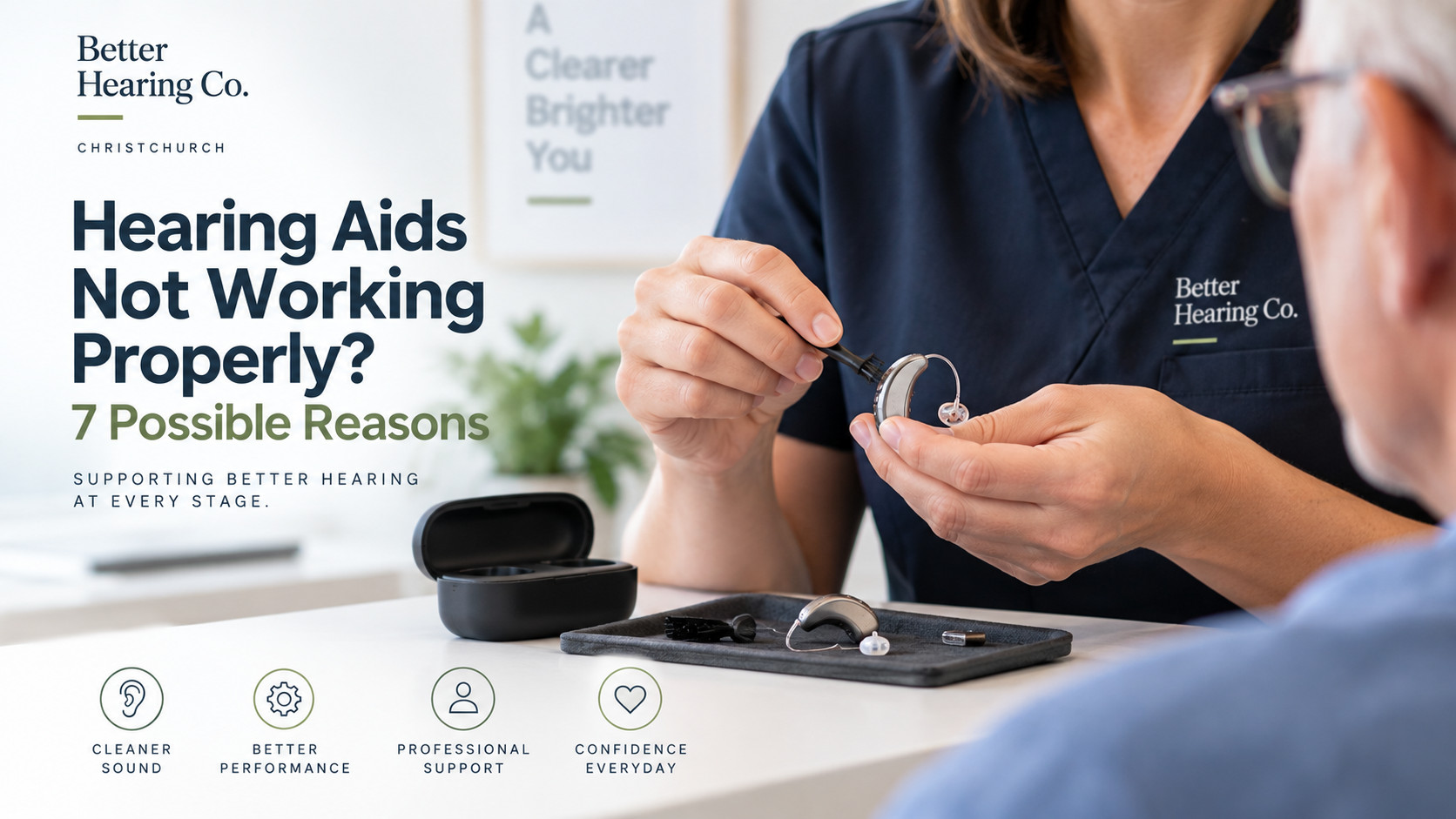
Hearing aids are designed to make important sounds easier to access, but their performance can change over time.
Perhaps conversations no longer sound as clear as they once did. Maybe one device seems quieter, background noise has become difficult again or your hearing aids simply do not feel as comfortable as before.
This does not automatically mean that you need new hearing aids.
Sometimes a professional hearing aid adjustment in Christchurch can identify and address the problem.
Here are seven possible reasons your hearing aids may not be performing as expected.
1. Your Hearing May Have Changed
Hearing levels are not necessarily static.
If your hearing has changed since your devices were originally programmed, the settings may no longer provide the most appropriate amplification for your current hearing.
This is one reason periodic hearing reviews can be useful.
An updated hearing assessment can compare your current results with previous results and help determine whether reprogramming should be considered.
2. Ear Wax May Be Affecting the Sound
Earwax is natural, but excessive wax can affect both your hearing and hearing-aid performance.
Wax can block the ear canal and make sounds seem quieter or less clear. It can also interfere with parts of a hearing aid, particularly receivers, earmoulds and wax filters.
If a device suddenly seems weaker than usual, checking both the hearing aid and the ear can be worthwhile.
Avoid trying to remove deep wax with cotton buds, as this can push it further into the ear canal.
3. The Hearing Aid May Need Cleaning or Maintenance
Hearing aids spend many hours each day exposed to skin, moisture and earwax.
Over time, microphones, receivers and filters can become obstructed.
Sometimes what appears to be a major hearing-aid problem is related to maintenance.
Regular cleaning and appropriate device care can help, while a professional check can identify issues that may not be obvious from looking at the device yourself.
4. Your Listening Needs Have Changed
Your lifestyle may be different from when your hearing aids were originally fitted.
Perhaps you now spend more time in meetings, restaurants, community groups or other noisy environments.
Hearing-aid programming that worked well for your previous routine may not provide the experience you want in these new situations.
Tell your audiologist about specific environments where you are having difficulty. Real-world examples can provide useful information when reviewing hearing-aid settings.
5. The Physical Fit May Need Attention
A hearing aid should sit appropriately and comfortably.
Changes to earmoulds, domes, tubing or other components can sometimes improve physical fit or sound delivery.
If your hearing aid has become uncomfortable, moves around excessively or produces frequent whistling, it is worth having the fit checked rather than simply tolerating the problem.
6. The Programming May Need Fine-Tuning
A hearing-aid fitting is not necessarily a one-time event.
People experience sound differently, and adjustments can sometimes be required after you have used the devices in everyday situations.
You may notice that certain sounds are too sharp, voices need greater clarity or some environments are still challenging.
Fine-tuning gives your audiologist an opportunity to review these experiences and determine whether appropriate programming changes can be made.
7. The Device Itself May Need Checking
Like other electronic devices, hearing aids can develop faults.
Battery problems, charging issues, damaged components or receiver problems may affect performance.
If one hearing aid suddenly stops working or becomes significantly quieter than the other, a device check can help determine whether cleaning, adjustment or repair may be required.
Do You Automatically Need New Hearing Aids?
No.
If your existing hearing aids are not working as well as expected, replacing them is not always the first step.
A review can look at your current hearing, your ears, your devices and their programming before deciding what is appropriate.
In some circumstances, existing hearing aids may be able to be reprogrammed or fine-tuned.
What Happens During a Hearing Aid Review?
Depending on your needs and devices, a review may include an ear examination, updated hearing assessment, hearing-aid check, discussion of the difficulties you are experiencing and adjustments where appropriate.
The goal is to understand the reason for the problem rather than simply increasing the volume.
Hearing Aid Adjustment in Christchurch
If your hearing aids no longer sound as clear or comfortable as they once did, you do not necessarily have to put up with them.
Better Hearing Co. provides hearing reviews, device checks, reprogramming and hearing-aid fine-tuning in Christchurch where appropriate.
Book an appointment and bring your hearing aids with you. A professional review can help determine whether your current devices can be adjusted to better suit your hearing and everyday listening needs.